top of page


Blog: Blog2
Get in Touch.

Blog: Blog2 Custom Feed
Blog: Contact
Search
Bayou Bend - Houston, Texas
- Ali Lam

- Oct 9, 2019
- 11 min read
This historical collection includes twenty-eight rooms full of different eras, all pulled together in one enormous house found in River Oaks, on the bend of Buffalo Bayou, all put together by Miss Ima Hogg, her interior designers, and a few designers from the Museum of Fine Arts Houston. The Architect of this stunning Latin Colonial style home was John Stubb, who constructed it in 1928. Although through the years many alterations have been made throughout this house, furniture collections changed periodically, the landscape has stayed precisely the same as when Miss Hogg had originally designed it.
The lands


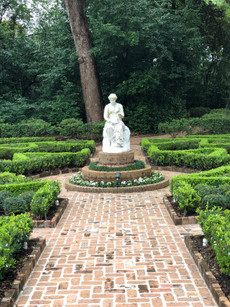









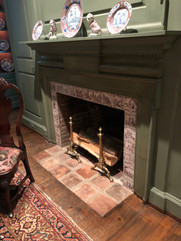













cape has been kept the same, so much as to every tree that ever died in a storm has been replaced with exactly the same type of tree, to keep Miss Hogg’s fourteen acres of beautiful gardens to remain exactly the same as the original. Hogg was a collector of only the finest materials anywhere from 1620 to 1870. These collections of hers are mostly American because she could find local pieces in the U.S. to bid on and buy, which would be a lot cheaper than having pieces shipped from across the world.
“Today, nearly 2,500 objects installed in twenty-eight period room settings showcase the evolution of American taste from the Colonial through the Victorian eras, including furnishings, paintings, silver, ceramics, and glass. Outside, visitors stroll through surrounding woodlands and a series of gracious and beautiful gardens that Miss Hogg intended as outdoor rooms for living and entertaining, not just views to be admired from within the house”(MFAH).
When collector Ima Hogg turned seventy-five, she decided to donate her home and all the furnishings in it to Museum of Fine Arts Houston. For nine years she transformed the home into sections of different periods, and it was finally opened to the public in 1966.
Dining Room: Up until the American Revolution, it was very unlikely to have a dining room, and even then only the wealthiest had them. One of the styles collected through this room is Federal American, such as the Hepplewhite with Sheraton inspired chairs and highboy. Neoclassical elements also enhance the space, such as the sideboard at the entrance of the room. The beautiful tableware decorating the table are also Federal American. Although the walls appear to be wallpaper, they are actually hand painted canvas, with gold leaf shimmering through the entire space.
Chillmen Suite: This room was originally used as a waiting area and quarters for the Hogg’s servants. This room is covered in Empire and Neoclassical style, and includes a few wedgewood urns, klismo chairs, philly easy chairs, pier tables, and even a cellarette. It was sectioned off as several rooms back when the mansion was first built, but later the interior decorator opened it up into one big area including a foyer and parlor. The carpet is based on the original wall to wall woven carpet from the original time period, 1950s to 1960s. This room was named after the interior decorator, Dorothy Dawes Chillman, who helped Hogg during her nine years of organizing her rooms and collections for the museum.
Belter Parlor: This parlor was decorated in the 1800s and named after John Henry Belter, who was a manufacturing cabinet maker. The bright, red Victorian American, Rococo Revival style sofas, are most likely a replica of Belter’s manufactured settee, and they rest as one of the focal points in this parlor. The other main focal point is the fireplace, hand carved, with turtle doves and wildflowers covering the entire front. The space has many custom shelves, created especially for knick-knacks that the homeowners would bring back from traveling the world. On display is a handmade shell case, that back in the day the women would collect shells and dried flowers and create beautiful sculptures that could draw attention to the collections and fine pieces in their homes.
Music Room: This room is in between Federal American and Empire style, with a few Greek and Roman elements scattered throughout. Looking at the space, it is obvious it was a time in life with more leisure, with a card table in the middle of the room for playing games or drinking tea, and a square pianoforte right in front of the door, made by Gibson and Davis of New York. This room was a way to show off and reflect all their travelings, examples, such as the India influenced 2-dimensional canvas across all four walls, late Neoclassical tiger maple wood lyre back chair, the Hitchcock chairs in the left corner of the space, and the hand painted landscape. Even with all the different cultured pieces, it remains a Patriotic style. “Installed in 1993, the example that covers the Music Room’s walls features a French reproduction of an 1806 design called Hindustan, which signals the contemporary Western interest in the exotic”(MFAH).
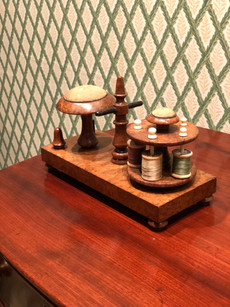
McIntire Room: This room was originally named because the museum thought they had more Samuel McIntire inspired elements then they actually did, the only thing McIntire in it is the Federal American chair in the left corner of the room. The thing about this chair is that there is no way to really know if it is an original McIntire or just a copy from his guide book because as of right now, there has not been any indications as to how McIntire labeled his original pieces. The other influence flooding the room, is Chinese. The table at the end of the bed is hand painted with chinese influence and the whole bed is covered in chinese style buildings and plants. It is easy to see that this room reflects the role of womanhood, with many girly elements, such as the old fashion sewing kit on the dresser, hand stitched wall hangings, and the overly draped bed.
Chippendale Bedroom: This beautiful bright, red room is known as the Chippendale Bedroom because of a few of the elements throughout the room sporting this name. All the materials for this space would have been imported. The photo on the left is an original George II secretary “office” desk. This secretary was a computer of the day for these early Americans, because all their important files were stored in this one piece of furniture. The side chairs next to the secretary appear to be a clean mix of George II and New York Style. On the opposite wall is a chest of drawers with a serpentine front bombe. There are a few pictures decorating the walls in this room, one of them very humorous, and the other one a picture of a little child wearing a pink dress. This picture was researched and found to be a boy because of the type of toy he is playing with. The reason the little boy was wearing a dress is because back in the day before a child was breached, it was easier to change them.
Maple Bedroom: This room was known as a “Middle Class Room” which still appears very beautiful and packed with furniture. One difference about this bed from the others is that the mattress is held up by ropes. A few of this interior includes a stenciled border of pine-cones and leaves around the room, 18th-century paneling, a Windsor chair in the corner of the space, a foot-warmer, Queen Anne chair, Connecticut Highboy, and even a painting of a man who was in debtor’s prison and Miss Hogg helped get out. The concept of this space was to get a feel of what it was like and what objects could be found during the 18th century in common rural areas of Northeast America.
Queen Anne Suite: Although the whole mansion reflects Hogg’s taste in furniture, this room really signifies her favorites because it served as her personal bedroom. Originally Hogg wanted to cover the whole second story with natural imported wood, but when it arrived most of it was rotten and molded. By deciding to cover just her suite in the wood she was able to save money and use a cheap local wood for the rest of the house. This room was named because of the many Queen Anne style pieces, however, there are a few elements that are not. A few of the other elements in the space are a Chinese lacquered highboy, Asian influenced chinaware, and a game table in the center of the sitting area. One of Hogg’s first inspirations to start collecting American furniture was a chair that remains standing in her bedroom to the right of her fireplace. When Hogg finally had the chance to buy this New England armchair, that began her collections. She outgrew its design and did not necessarily like it anymore, but she kept it in her bedroom as a motivation. Behind her bedroom accommodated Hogg’s bath and dressing room that was eventually converted to the room which contributes to her interests and civic contributions.
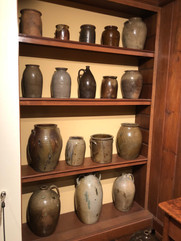
Texas Alcove: This is a space between halls that displays many different handmade potteries. One of the elements in this collection includes a tempestuous jug, which would supposedly happen if the spirits were drunk.
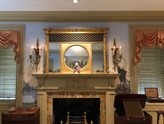
Federal Parlor: This room belonged to William Hogg, Ima’s older brother, and it served as his bedroom when the house was still a residence. One of the coolest things about this room is the fireplace. When Ima Hogg first started collecting pieces for her home she found this piece and imported it here, she thought it looked like a Robert Wilford piece but there was never any evidence she could find that it actually was. Years later when the piece was excavated clean, his signature was found in the center of the mantel and it was indeed an original carving of his. This blue parlor includes French-inspired paper printed wallpapers with two pigeons floating on the nest, a tilt top fire screen protector, eagle wall sconces, Sheraton side chairs, a Neoclassical buffet table, a secretary desk, and even a painting of Will Hogg’s wife, who was known as a drunk.
Newport Room: This room once belonged to Ima’s brother, Mike Hogg, who was the youngest of them all. The space now includes many Chippendale elements, Queen Anne chairs, a Windsor Back chair, and even some chinaware. “The Newport Room paneling is based on the parlor of the Hunter House, built in 1748 in Newport, Rhode Island. The influence of Newport’s regional style of this time is evident elsewhere in the room as well. The motif of a carved, stylized shell, synonymous with Newport furniture, appears in the room’s concave alcoves and on the elegant mahogany desk and bookcase”(MFAH).
Texas Room: Completely remodeled, this space was originally purposed as a bath and dressing room for the Hogg boys. It now functions as the Texas Room, that holds all of the mansions ceramics and silver dishes, made in Central Texas by the Germans, to “commemorate the Texas War of Independence and the Mexican-American War”(MFAH). In the right corner of the room is a “Texas Chair” made of horns and cheetah fur.
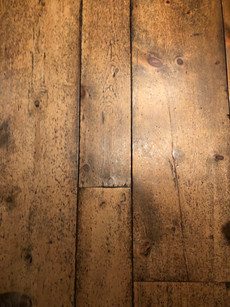
Murphy Room: This room is taken back to English living in the colonies. It remains to include some of the oldest pieces on the Bayou Bend site, such as ladder back chairs and a hadley chest of drawers. Lying on the table in front of the stairs is a rug, used as a table covering because it was too nice to use on the actual floor. The painted checkered floors are inspired by late 17th century Boston portraits, but it most likely would have originally just been soil or natural bare wood.
Massachuchets Room: The vibrant space can catch the eye at first glance. The bright, mustard yellow chairs contrast elegantly with the solid, blue walls wrapping around the room. This space is pulled back to a Revolutionary era. To the left of the entrance of this room is a secretary desk with a roller chair. It is a funny looking chair, but was very purposeful back in its day. Everything in the room is tied so well together, with all the Chippendale chairs and settee with matching upholstery with the easy chair at the fireplace. In this room is a painting of a three year old boy, painted by Thomas Bager. This was the very first painting purchased by Miss Hogg.
Pine Room: This space once served as a library for the Hoggs but was eventually panelled to cover the bookshelves. Now, these beautiful wood wall panels can open up revealing floor-to-ceiling shelving, but can also be closed to keep things neat looking. An Early Baroque style is scattered throughout the parlor, with a few Queen Anne chairs and a Philly Chest that looks like some sort of marquetry or black lacquer is applied to it.
Drawing Room: When Hogg left her mansion to the Houston Museum of Fine Arts, this room has continued to remain exactly the same throughout its time as an exhibit. Other rooms in the house have been modified, and furniture has moved in and out of the other rooms, but this one has been kept completely original to how she designed it. The Drawing Room is the largest room in the whole house, and holds a lot of elegant historical pieces, such as the Georgian highboy, chairs, and easy chairs. The highboy appears to be Chippendale, with chamfered corners. There are a couple of tilt-top tables in the room, including a three-legged, pie crust table in the corner of the room which is made by Biedermeier. In addition to the tilt-top tables, there are a few coffee and end tables along with some game tables to keep guests entertained.
Philadelphia Hall: This stunning hall is the formal foyer to Bayou Bend. It has Rococo Style elements like the chest of drawers and chairs. The stairs are recognized as a copy of the Governor's Mansion in Austin, which is one of the houses the Hogg children happened to grow up in. There is only one painting on the wall in this space, which is a stunning self portrait of Ima Hogg herself.
There are many differences in the furniture pieces throughout the rooms because of the time frames and where they are originally imported from. The Queen Anne chair is different from a Hepplewhite because firstly, Hepplewhite made a book to follow his chair design and people eventually took some of his designs and mixed it with other styles, creating a unique chair. Secondly, Queen Anne style was a phase of furniture making going for a sleek and curvy look, while Hepplewhite was looking at something more broad and slightly more masculine. Furniture makers and designers represented throughout the time Hogg did her collecting were Hepplewhite, Sheraton, Chippendale, Biedermeier, McIntire, Belter, and even Seymour.
Describing some of the furniture pieces throughout the spaces, in the Chillman Room are some Neoclassical Klismo chairs, that are wood framed and contain upholstered seats. The back of these chairs are not embellished as much as some of the furniture in the mansion, but they are beautifully hand-painted, with a curved back. In the Drawing Room is a completely upholstered Philadelphia Easy Chair that was the first type of reclining seat of the time. Chairs were not typically for reclining back into, but more of a designated spot to sit straight up, and people were not usually entitled to sit back in their seats.
Seeing this furniture in person gives me first hand view of traveling back in time. Miss Hogg and the design team at Houston Museum of Fine Arts did an astonishing job replicating the spaces to fit the time the furniture was originally designed. Although I can find something in each room that amazed me, one of my absolute favorite art exhibits would have to be the Massachusetts Room. The dramatic dark blue and bright, mustard yellow contrasted phenomenally. The Chippendale chairs and settee matched beautifully with the cozy easy chairs next to the fire place, the orange tiles on the floor are the same orange tones in the Colonial style painting above the mantel, and the whole space is tied together by a colorful rug in the middle of the floor. My favorite feature during the tour was the secret bookcase hidden behind paneling in the Pine Room. Most of the paneling in the Pine Room actually opens up, giving the room lots of storage to hide away knick-knacks and books.
I believe it is important that this mansion stays a historical influence for the museum because there are not many houses around Houston quite like Bayou Bend. The rooms take you back in time, developing through each space, giving you a glimpse of what it was like back then. Going on this tour impacted my horizons not by showing me a few power points of what the chair used to look like in the 1730s, but actually getting to look at this furniture as a complete three-dimensional model, seeing the texture of the original upholstery that it is covered in, to the wood that has started tarnishing from years of exposure.
Work Cited:
"The Period Rooms at Bayou Bend." The Museum of Fine Arts, Houston, www.mfah.org/
visit/bayou-bend-collection-and-gardens/bayou-bend-virtual-tour/.



bottom of page
Comments